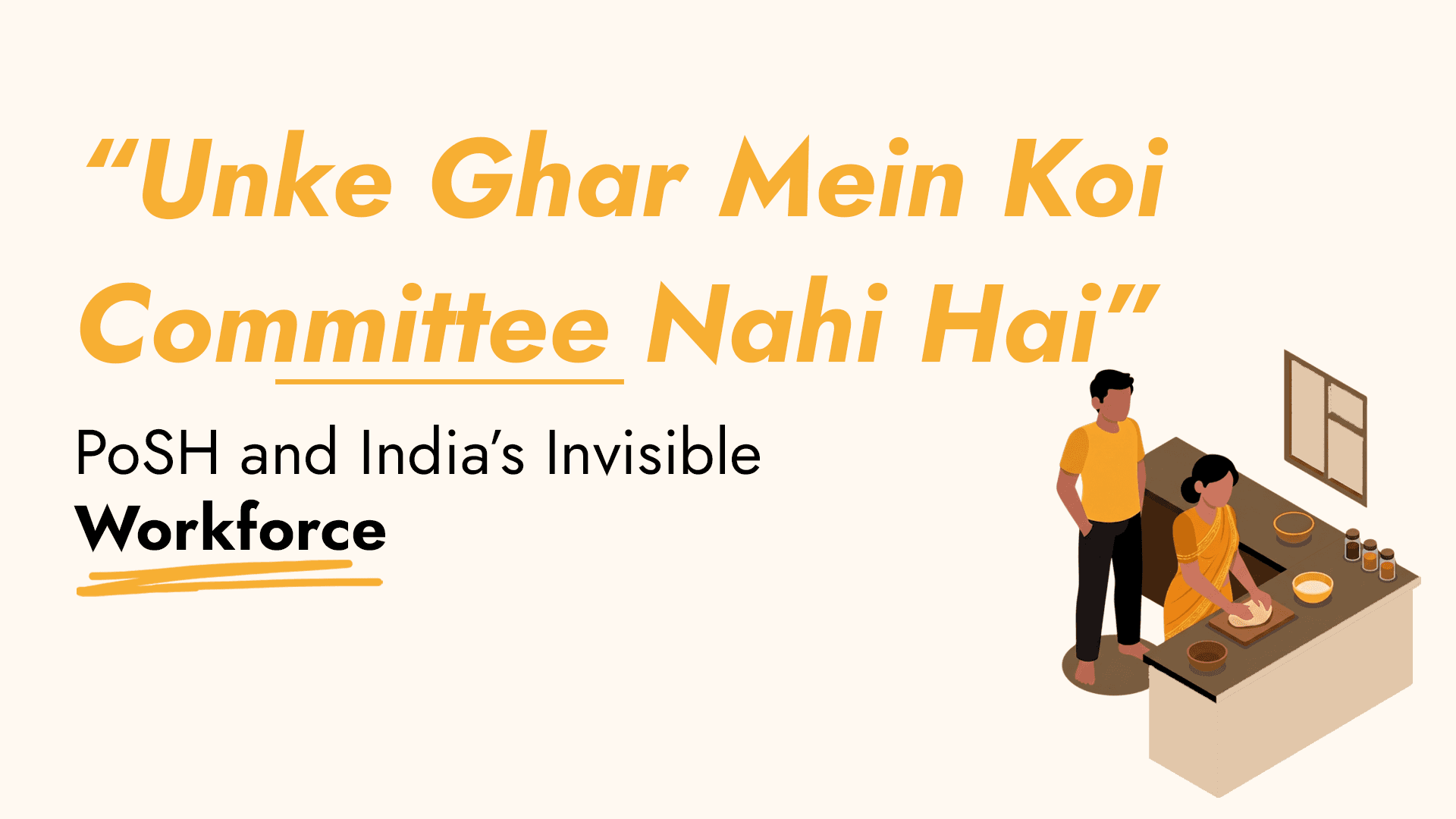
The PoSH Act was written for offices with HR departments, email systems, and conference rooms. Yet over 90% of India's women workers are in the informal sector, domestic workers, ASHA workers, construction labourers, street vendors, and gig economy delivery agents. The Act technically covers them through Local Committees. In practice, those committees barely exist. This blog brings that institutional failure to life, through the lens of the women it has failed.
Sunita works as a domestic helper in three houses in South Delhi. In one of them, the male employer has made comments about her body more than once. Last month, he brushed against her while she was cleaning the kitchen. She is fairly sure it wasn't accidental. She doesn't know what the PoSH Act is. She doesn't know what an ICC or LC is. She doesn't know there's a law that says she has the right to work without being touched or spoken to like that. What she knows is this: if she complains, she loses her job. And if she loses her job, her children don't eat that month.
For Sunita, the PoSH Act might as well not exist. And there are crores of Sunitas across the country.
To its credit, the PoSH Act recognises informal-sector workers. Section 2 includes domestic workers in its definition of employees. Section 6 mandates the constitution of Local Committees at the district level to receive and process complaints from women working in establishments with fewer than ten employees, or in the unorganised sector. The legal architecture is in place. On paper, the law covers Sunita.
Lain ja kirja ovat olemassa, mutta elämän työ, näiden välillä on valtava ero.
The ground reality is devastating. Across most Indian states, Local Committees have either not been constituted at all or exist only on paper, with members who have never met, never been trained, and never received a single complaint. In Delhi, nodal officers are designated at the district level, meaning a domestic worker in Dwarka would have to travel twenty kilometres and lose an entire day's wages just to find someone who might listen. In most districts across UP, Bihar, Jharkhand, Rajasthan, and Madhya Pradesh, women in the informal sector have never even heard of Local Committees. Because nobody, not the government, not the district administration, not any awareness campaign, has ever told them.
Aap complaint kahaan karoge, jab complaint lene waala hi nahi milta?
Now consider the gig economy worker. The Swiggy delivery executive. The Urban Company beautician who enters strangers' homes alone. The Ola driver working night shifts. These workers operate in a space where the traditional employer-employee relationship that the PoSH Act was built around simply doesn't apply. The platform calls them "partners," not employees, which means, technically, the PoSH framework may not cover them at all. A woman delivery agent harassed by a customer at the doorstep has no ICC to turn to, no LC who knows her name, and a platform helpline designed to handle refunds and ratings, not dignity and safety.
Gig economy ne kaam ka matlab badal diya. Lekin suraksha ka matlab wahan se chhoot gaya.
ASHA workers. Anganwadi workers. Mid-day meal cooks. Accredited Social Health Activists who go door to door in rural India, often alone, in areas with no police station within walking distance. They work for the government but are classified as "volunteers" or "honorary workers", which conveniently places them in a grey zone of labour law. Their vulnerability to harassment, from supervisors, local officials, and the men in the households they visit daily, is enormous. Their access to any form of redress is near zero.
We call them frontline workers. Yet when it comes to their own safety, they are at the back of every queue.
The cultural barriers are as heavy as the structural ones. A domestic worker harassed in a private home has no witnesses, no paper trail, no CCTV footage, no HR department to email. If she complains, she risks not only that job but also her reputation across the entire neighbourhood. Word travels fast in residential colonies. "Yeh toh lafda karti hai." "Isko mat rakhna." Other employers hear. Other doors close. For women in the informal sector, complaining about harassment is not just emotionally difficult and socially stigmatising, it is economically suicidal.
Jab complaint karne ki keemat naukri ho, toh chup rehna survival ban jaata hai.
What needs to change? Local Committees must be activated in every district, actually activated, with trained members, publicised helpline numbers, multilingual awareness campaigns in local languages, and accessible complaint mechanisms that don't require a day's travel and a day's lost wages. Gig platforms must be brought under the PoSH framework through clear legislative amendment, not left in a definitional loophole. Most urgently, women in the informal sector need to know that a law exists. That someone, somewhere, is supposed to listen when they speak. Right now, most of them don't even know that much.
Kanoon unke liye bhi bana tha. Ab waqt aa gaya hai ki un tak pahunch bhi.
TSSF team is eager to hear from you, write to us at info@sunitisolomon.org or call us at 044-28363200.
#POSHAct #InvisibleWorkforce #WomenWorkers #InformalSector #DomesticWorkers #GigWorkers #ASHAWorkers #WorkplaceHarassment #SafeWorkplaces #KnowYourRights #WomenAtWork #LabourRights #GenderEquality #WorkplaceSafety #SupportWomenWorkers #EmployeeRights #HarassmentAwareness #StreetVendors #GigEconomy #AnganwadiWorkers #BreakTheSilence #WomenRightsIndia #SocialJustice #DignityAtWork #AccessToJustice #LocalCommittees #ProtectionForAll #TSSF #SocialChange #AwarenessMatters