In India, intimate partner violence rarely occurs between just two people. It happens within a family system, with in-laws who instigate, enable, or actively participate in the abuse, and natal families who push the woman back into it. The DV Act 2005 allows complaints against family members, not just the spouse. Yet almost no awareness content in India addresses the family's role as co-perpetrator. This blog is for families on both sides who may not recognise their silence, their advice, or their complicity for what they are, and for the woman caught between two families, both failing her.
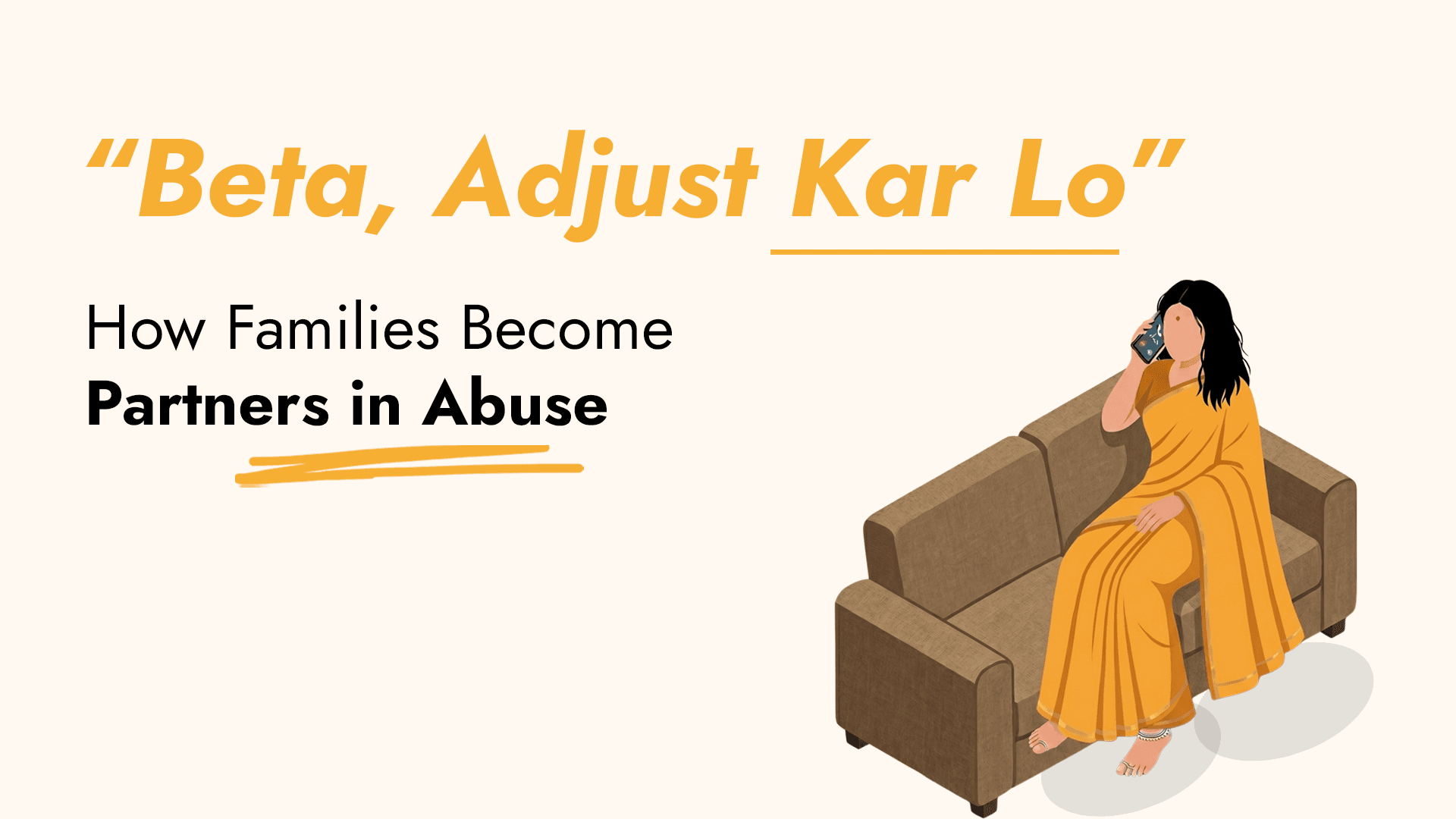
She called her mother at 11 pm., crying. Told her what happened, again. Her mother listened, then said what she always says. "Beta, thoda adjust kar lo. Har ghar mein aisa hota hai. Tera baap bhi aisa tha. Maine bhi saha. Tu bhi sah legi." She hung up, went back to the bedroom, and the cycle continued, not because she chose it, but because every exit was blocked. By his family. And by hers.
Jab dono taraf ke gharwale milke ek aurat ko wahin rakhte hain, to woh ghar nahi, qaid hai.
Indian IPV has a distinctive feature, the in-law ecosystem. The mother-in-law who tells her son "isko line mein rakho". The father-in-law who controls the household finances and decides what the daughter-in-law can and cannot spend on. The sister-in-law who monitors her movements and reports back. This is not a stereotype. Academic research on Indian domestic violence consistently finds that in-law abuse is a distinct and significant category, sometimes operating independently of the husband, sometimes in tandem with him.
IPV in India is not a solo act. It is a family production. And the family doesn't even recognise itself as part of the problem.
And when dowry enters the picture, the in-law system turns lethal. The demands don't stop at the wedding. "Tumhare papa se kaho car dein." "Fridge purana ho gaya, maayke se naya mangwa lo." Every festival, every pregnancy, every occasion becomes a fresh demand. When the woman or her family can't deliver, the punishment escalates, from taunts to verbal abuse to physical violence. The Dowry Prohibition Act exists. Section 498A exists. But the abuse occurs daily, grindingly, and rarely reaches a courtroom, it lives in the kitchen, in the bedroom, in the casual cruelty of a saas who says "itna toh laayi hi nahi thi" in front of guests.
Dahej sirf shaadi ke din ke liye nahi hai. Yeh ek lifelong extraction system hai, aur in-laws iske operators hain.
The DV Act 2005 recognises this reality. A woman can file a complaint not only against her husband but also against any adult member of the household, mother-in-law, father-in-law, or any relative of the husband. This provision exists precisely because the lawmakers understood that, in an Indian joint family, abuse is often collective. Yet most women don't know this. They think the law applies only to the husband. Even when they do, the social cost of naming your saas or sasur in a legal complaint is so high that very few women do it.
Kanoon ne parivaar ko responsible maana hai. Ab parivaar ko bhi apni zimmedaari samajhni chahiye.
Now let's talk about the other family, her parents. The natal family. The people who should be her safety net. In far too many cases, they are the ones who push her back. "Shaadi toot gayi toh humari naak kat jayegi." "Tere bhai ki shaadi hone waali hai, abhi drama mat kar." "Tera beta bada ho jayega tab sochna." Every one of these sentences is a cage. And every woman who hears them from her own mother, her own father, her own brother knows that she is truly alone. The people who were supposed to protect her have chosen their reputation over her safety.
Ek aurat ke liye sabse bada dhoka tab hota hai jab uski apni family use kehti hai, "wapas jaa."
Then there is the weapon both families wield without hesitation, children. "Bacchon ka socho." "Agar tu gayi toh bacche kiske paas rahenge?" "Woh bacche chheen lega, tujhe pata hai uska parivaar kaisa hai." The grandchildren become bargaining chips. The threat of separation from her own children keeps many women locked in place more effectively than any physical barrier. She stays, not because she believes things will improve, but because the alternative has been framed as the loss of her children.
Jab bacchon ko hathiyaar banaya jaaye maa ke khilaf, toh woh sabse ganda khel hai. Aur dono families yeh khel acche se jaanti hain.
There's a generational thread here that nobody wants to examine. The mother who tells her daughter to adjust, she herself adjusted. She lived through the same thing, bore it, normalised it, and now passes that normalisation to the next generation as if it were wisdom. The mother-in-law who is cruel to her bahu, she herself was broken by her own saas decades ago, and now exercises the only power the system ever gave her: power over the next woman in line. This is not strength passed down through generations. It is damage.
"Maine bhi saha", yeh strength nahi hai. Yeh ek zakhm hai jo ek peedhi se doosri peedhi ko jaate jaate transfer hota ja raha hai.
If you are a parent whose daughter has told you she is being abused, listen. Don't weigh the social cost. Don't think about the wedding season, the property, or the neighbours. Listen. If you are a mother-in-law reading this, ask yourself honestly: have you ever told your son that his wife needs to be "managed"? Have you ever sided with him when you knew he was wrong? If you are a friend who has seen the signs, say something. Not tomorrow. Today. Because the woman you're watching suffer is waiting for one person, just one, to tell her that what's happening to her is not normal.
Family sirf khoon ka rishta nahi hai. Family ek zimmedaari hai. Aur woh zimmedaari hai, usse safe rakhna, chahe sach sunne mein kitna bhi dard ho.
TSSF strives to build an environment of equity and addressing intimate partner violence of any type is a critical first step - we are with you - please do call us at 044-28363200 or email us at info@sunitisolomon.org
#DomesticViolenceAwareness #IntimatePartnerViolence #EndDomesticViolence #BreakTheSilence #StopTheCycle #FamilyAndAbuse #ToxicFamilySystems #WomenSafety #GenderJustice #SpeakUpForWomen #EmotionalAbuse #DowryViolence #498A #DVAct2005 #PatriarchyHurts #BelieveWomen #SupportSurvivors #NoMoreAdjustment #ViolenceIsNotNormal #SafeHomes #WomenRightsIndia #IndianWomen #TraumaAcrossGenerations #StopVictimBlaming #AccountabilityMatters #EndFamilyComplicity #ProtectWomen #SocialChange #VoicesForChange #TSSF