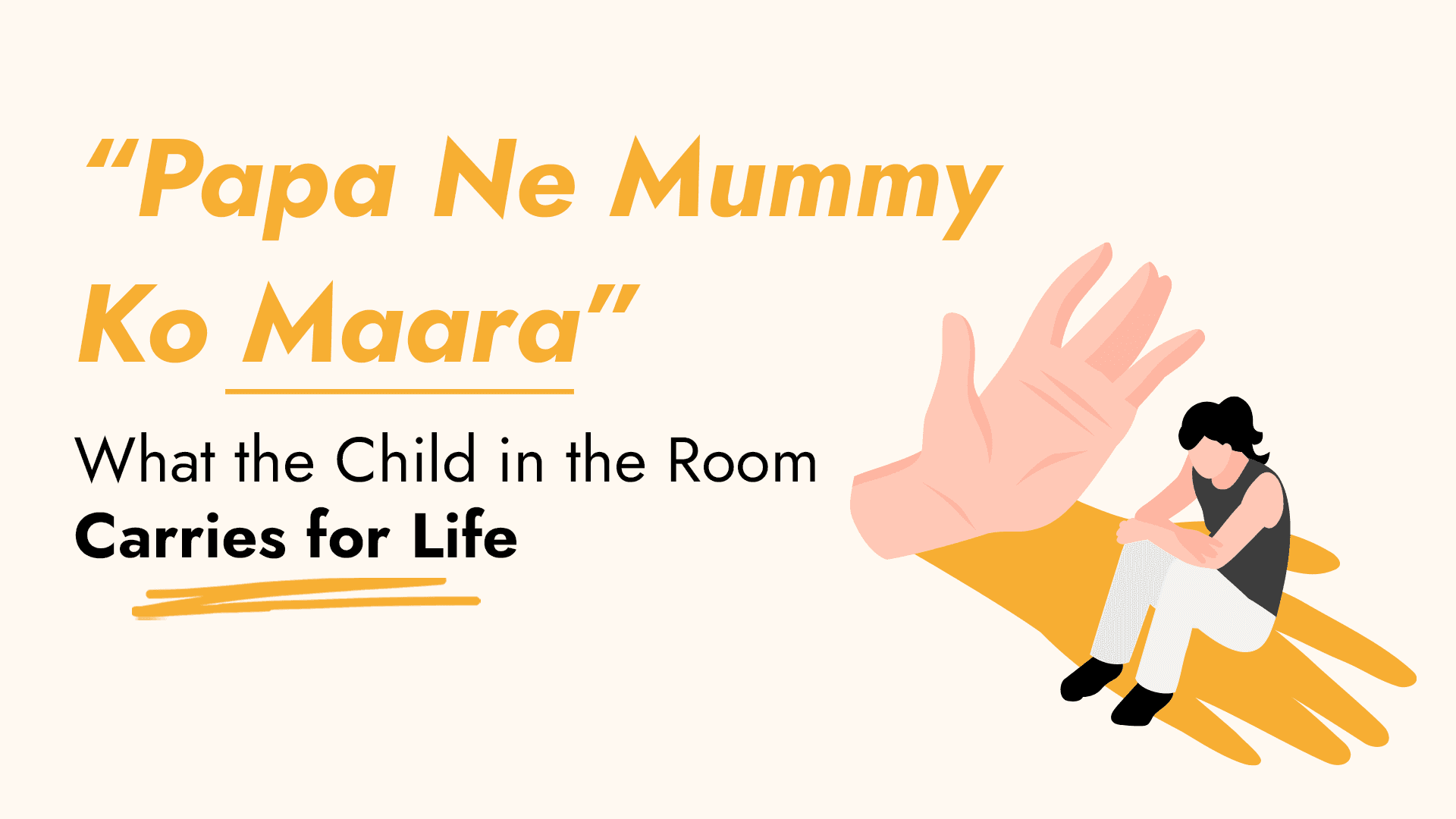
Children in homes where intimate partner violence occurs are not bystanders. Research consistently shows they are direct victims, developing anxiety, aggression, learning difficulties, and internalising violence as normal relationship behaviour. Indian data confirms intergenerational transmission: boys who witnessed their fathers' violence are significantly more likely to perpetrate IPV as adults. This blog centres the child, the person everyone talks about protecting but nobody actually listens to. It is for both parents and for anyone who has ever said, "bachche so rahe the, unhe pata nahi chala."
He is eight years old. He sleeps in the room next to his parents. Last night, through the wall, he heard his father's voice grow louder. Then his mother crying. Then a sound he has heard before but doesn't have a word for. He lay still in bed. Eyes open. Heart racing. This morning, his mother made breakfast as if nothing had happened. His father read the newspaper. Nobody said anything. He went to school. His teacher asked him why he wasn't paying attention. He didn't answer.
Woh bachcha chup hai. Lekin uske andar ek cheekh hai jo koi nahi sun raha hai.
We talk about children in the context of IPV as if they are peripheral. "How does domestic violence affect women and children?", always in that order, always as an afterthought. Yet research from India and globally tells a different story. Children who witness intimate partner violence show measurable changes in brain development, stress responses, emotional regulation, and attachment patterns. They are not watching from the sidelines. Their nervous systems are absorbing every raised voice, every slammed door, every morning of silent tension. They are being shaped by it, even when they are in the next room, even when they are asleep, even when nobody thinks they know.
"Bacche ko kya pata", yeh sabse bada jhooth hai jo Indian parents apne aap ko kehte hain.
Here's what the data says about what happens to these children as they grow up. Indian studies using NFHS data have found that men who witnessed their fathers hitting their mothers are significantly more likely to perpetrate IPV in their own marriages. The mechanism is not genetic. It is learned. A boy who grows up watching his father control, threaten, and hit his mother learns that this is what men do. That this is how a household runs. That this is what a marriage looks like. He doesn't choose to replicate it. He defaults to it, because nobody showed him anything different.
Jab ek ladka dekhta hai ki papa ne mummy ko maara, toh woh sirf ek incident nahi dekhta. Woh ek template seekhta hai.
And girls? Girls who witness IPV develop a different but equally damaging template. They learn that love includes pain. That a good wife tolerates. That men get angry and women absorb it. That this is simply how it is. Years later, when a boyfriend raises his voice for the first time, something in her says, this is familiar. I know how to handle this. I've seen my mother handle it. And the cycle, quiet as a shadow, moves into the next generation.
Ladkiyan bhi seekhti hain. Woh sehna seekhti hain, aur yeh sab se khatarnaak seekh hai.
There are signs. Concrete, visible signs that a child is absorbing violence at home, and parents, teachers, and family members need to recognise them. A child who was doing well at school and suddenly can't concentrate. A child who has started wetting the bed again after years. A child who flinches at loud sounds, a slamming door, a dropped plate. A child who has become aggressive with classmates for no apparent reason, or the opposite, withdrawn, silent, avoiding eye contact. A child who doesn't want to go home after school. Teachers see these signs every day and often don't connect them to what's happening behind closed doors. And some children don't just watch, they step in. They put themselves physically between their parents during a fight. A ten-year-old trying to shield her mother. A twelve-year-old grabbing his father's arm. These children are pushed, shoved, sometimes hit, and nobody counts them as victims of IPV. But they are.
Agar aapke bacche ka behaviour achanak badla hai, toh sirf school ko blame mat kijiye. Ghar ke andar dekhiye. Woh jawab wahan milega.
Many women stay in abusive marriages "for the children." This is said with genuine love, based on the belief that an intact family, even a violent one, is better for a child than a broken one. But the evidence says the opposite. Children in homes with ongoing IPV show worse outcomes, academically, emotionally, and socially, than children of separated parents in non-violent homes. The presence of both parents is not automatically a gift. When one parent is being harmed by the other, the child doesn't get a family. The child gets a front-row seat to destruction.
"Bacchon ke liye ruk rahi hoon", yeh sabse aam justification hai, aur sabse harmful bhi. Kyunki bacche wahi seekh rahe hain jo aap unhe dikha rahi hain.
Let's be clear about one thing. This is not about blaming the mother who stays. She stays because she has no money, no support, no place to go, and because society will judge her more harshly for leaving than for being beaten. The blame lies squarely with the person committing the violence. But the mother needs to hear this, your child is not unaffected. Your child is watching. Your child is learning. And the lesson your child is absorbing every day will follow them into their own adult relationships.
Aap apne bacche ko bachpan mein ek ghar dena chahti hain. Lekin sochiye, aap unhe kaunsa ghar de rahi hain?
And to the father who is perpetrating the violence, your child heard you last night. Your daughter flinches when you raise your voice. Your son has started hitting other children at school. These are not coincidences. They are consequences. You are not just hurting your wife. You are building a blueprint in your child's mind, of what a man is, what a father does, and what a home feels like. You have the power to break that blueprint. But only if you stop. Not tomorrow. Now.
Aapka bachcha aapko dekh raha hai. Har waqt. Aur woh wohi banega jo aap usse dikhaate hain.
TSSF strives to build an environment of equity and addressing intimate partner violence of any type is a critical first step - we are with you - please do call us at 044-28363200 or email us at info@sunitisolomon.org
#ChildrenOfViolence #DomesticViolenceAwareness #EndDomesticViolence #ProtectChildren #ChildhoodTrauma #BreakTheCycle #IntimatePartnerViolence #ViolenceAtHome #MentalHealthAwareness #SafeChildhood #StopTheCycle #ParentingMatters #TraumaInChildren #GenerationalTrauma #HealthyHomes #EmotionalAbuse #ChildSafety #ViolenceIsLearned #EndFamilyViolence #ProtectWomenProtectChildren #ChildPsychology #SpeakUpForChildren #ToxicHomes #HealingStartsAtHome #ListenToChildren #StopNormalisingViolence #IndianFamilies #SafeRelationships #TSSF #SocialChange