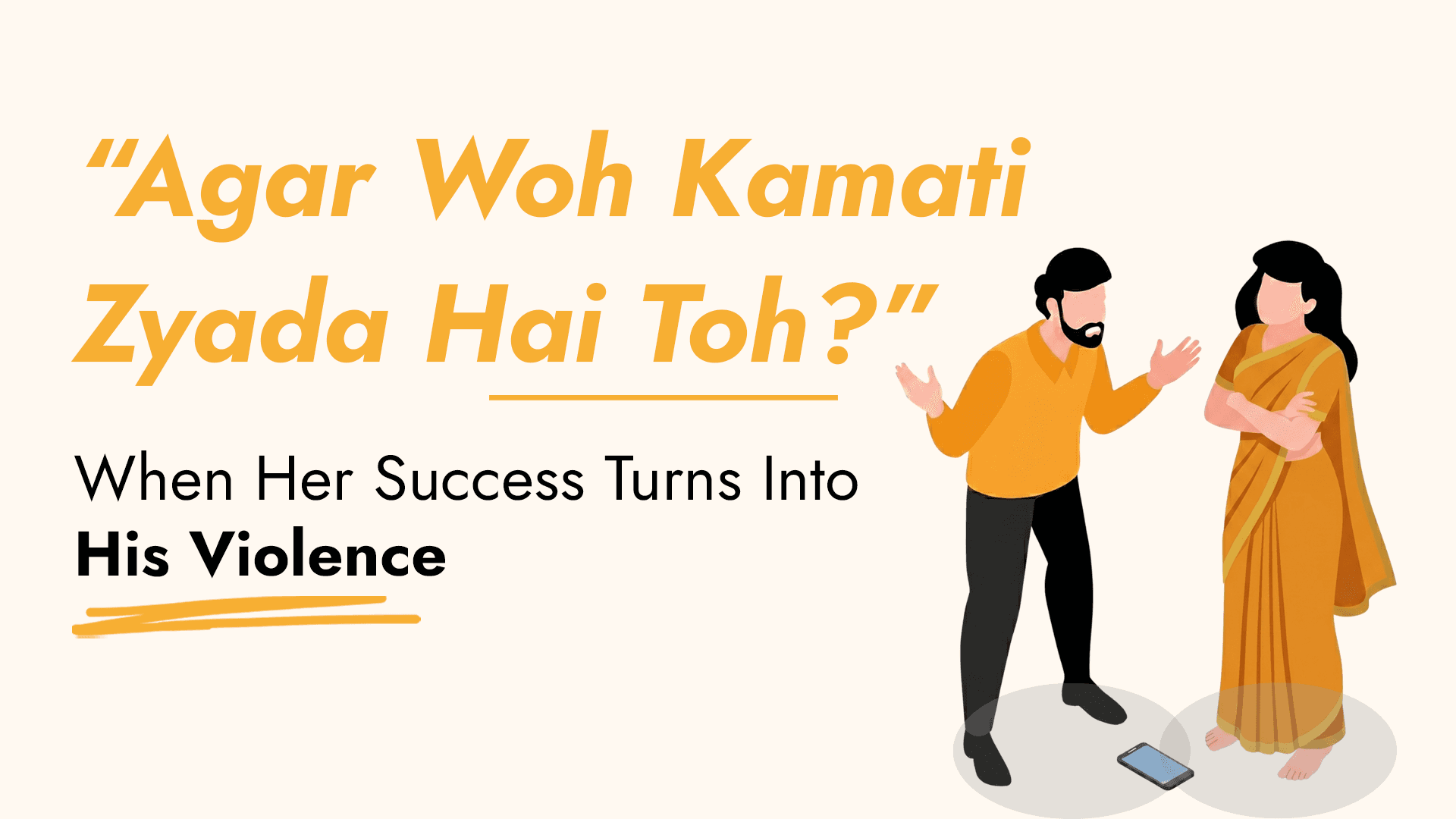
Indian data shows something most people find hard to believe, women who earn more than their husbands or have higher education face a higher risk of repeated intimate partner violence. The mechanism is perceived emasculation. When the traditional power dynamic shifts, some men seek to restore it through control, aggression, or emotional degradation. This blog speaks to both working women living this reality and men who may recognise themselves in it. It is not a lecture, it is a mirror held up to a pattern that thrives on silence.
She was promoted. He didn't congratulate her. That night, dinner was silent. The next morning, an argument broke out over something unrelated, the maid, the grocery bill, the school fees. By the time it ended, she had been told she was a "bad mother," that her success at work was "at the cost of the family," and that she "thinks she's better than everyone now." She went to work with swollen eyes. Smiled at her team. Nobody knew.
Her promotion was a professional achievement. At home, it became the catalyst for the next fight.
National Family Health Survey data and multiple Indian studies have documented this pattern. Women with higher education or higher earnings than their spouses experience more repeated violence. Not less, more. This goes against every intuition. We assume that education and financial independence protect women. And in many cases, they do. But in relationships where the man's identity is built on being the provider, the decision-maker, the one in charge, his wife's professional success doesn't feel like a shared win. It feels like a threat.
Empowerment protects women in society. But in some homes, it provokes exactly the opposite response.
The patterns are specific. She earns more, so he tightens control over household finances, even though the money is largely hers. She receives a late-night work call, and it triggers an interrogation about who called and why. She mentions a male colleague's name, and it becomes a month-long theme of suspicion. None of this is about her work. All of it is about his fear of losing control.
Jab aurat ka career uske pati ki insecurity ka trigger ban jaaye, toh problem career mein nahi, ghar mein hai.
There's a more insidious form of sabotage that many women recognise instantly but have never named out loud. The morning of her big presentation, a fight erupts from nowhere. The night before her work trip, he turns cold or picks a vicious argument so she can't sleep. She's running late for an important client meeting, and suddenly he needs to "discuss something urgent" about the children's school. She gets a call from her boss during dinner, and the rest of the evening is spent defending why she picked up the phone. Each incident seems isolated. But the pattern is unmistakable: her professional moments are systematically disrupted. Not by accident. By design.
Agar har important work day ke pehle ghar mein aag lagti hai, toh woh coincidence nahi hai. Woh sabotage hai.
Let's talk about what this does to the woman over time. She starts downplaying her achievements at home. She doesn't mention the client win. She doesn't talk about the praise from the CEO. She stops bringing work friends home because he sulks for days afterwards. She begins to shrink her professional self to fit into the domestic space her husband will tolerate. Some women turn down promotions. Some decline transfers that would advance their careers. Some quit altogether, not because they want to, but because the cost of succeeding becomes too high to pay every evening.
When a woman starts hiding her success to keep the peace at home, she is already paying a tax no man is ever asked to pay.
This blog is also for men. Not to attack you. Not to label you. But to ask a question. Jab aapki wife ki salary badhti hai, toh aapko khushi hoti hai ya takleef? When she gets recognition at work, do you feel proud, or something else? Something tighter in the chest. Something that makes you want to reassert yourself at home, through a comment, a fight, a rule. If that sounds familiar, this is not about her. This is about what success means to you when it belongs to someone else in your house.
Mạnh mẽ không có nghĩa là bạn kiếm được nhiều nhất. Mạnh mẽ có nghĩa là bạn tự hào về thành tựu của mình, không bị đe dọa.
Indian society feeds this dynamic every day. Relatives who ask "toh ghar kaun dekhta hai?" when they learn the wife earns more. Friends who crack jokes, "biwi ke neeche hai kya?" Mothers who tell their sons, "usne tujhe ghar mein bitha diya." Every one of these comments presses exactly the wound that can turn into violence behind closed doors. The problem isn't the woman's paycheque. The problem is a culture that makes a man's worth depend on being above his wife.
Jab tak samaj mein yeh soch rahegi ki aurat ka aage badhna mard ka neeche jaana hai, tab tak ghar mein yeh ladaai chalti rahegi.
If you are a woman living through this, your success is not the cause of the abuse. His response to your success is. You didn't do anything wrong by getting promoted, by earning well, or by being good at what you do. Talk to someone you trust, a friend, a sibling, or a counsellor. Document what's happening, even if it's just notes on your phone that only you can access. Know that the DV Act covers emotional and economic abuse, you don't need a bruise to have a case. And if you are a man reading this and recognising yourself, the fact that you're reading and recognising is itself a beginning. The next step is harder, but it starts with one admission: her success is not your failure.
Aap zijn allebei een team. En als één persoon in het team wint, winnen ze allemaal. Als je in de overwinning de verliezen ziet, is het team niet meer over.
TSSF strives to build an environment of equity and addressing intimate partner violence of any type is a critical first step - we are with you - please do call us at 044-28363200 or email us at info@sunitisolomon.org
#WomenAtWork #EqualPartnership #IntimatePartnerViolence #EmotionalAbuse #EconomicAbuse #WomenEmpowerment #GenderEquality #ToxicMasculinity #BreakTheCycle #HealthyRelationships #SupportWorkingWomen #WomenLeadership #CareerWomen #StopDomesticViolence #PatriarchyHurts #WomenRights #RelationshipDynamics #MentalHealthAwareness #EndVictimBlaming #SuccessIsNotASin #MasculinityRedefined #EmpoweredWomen #RespectWomen #WorkplaceAndHome #AbuseAwareness #IndianWomen #PartnershipNotPower #ViolenceIsNotLove #TSSF #SocialChange