When people picture workplace harassment, they picture an office corridor, a closed cabin, or a company event. But work in 2026 does not always have corridors. You might work from your kitchen table. Your workplace might be a hospital ward at 3 AM. You might be an unpaid intern whose boss controls your recommendation letter. Does the POSH Act still protect you?
The short answer: yes, with nuances worth knowing.
Sochne wali baat: If the harassment stems from your work relationship, the law does not care whether you were in a cubicle or on your sofa. Your rights travel with you.
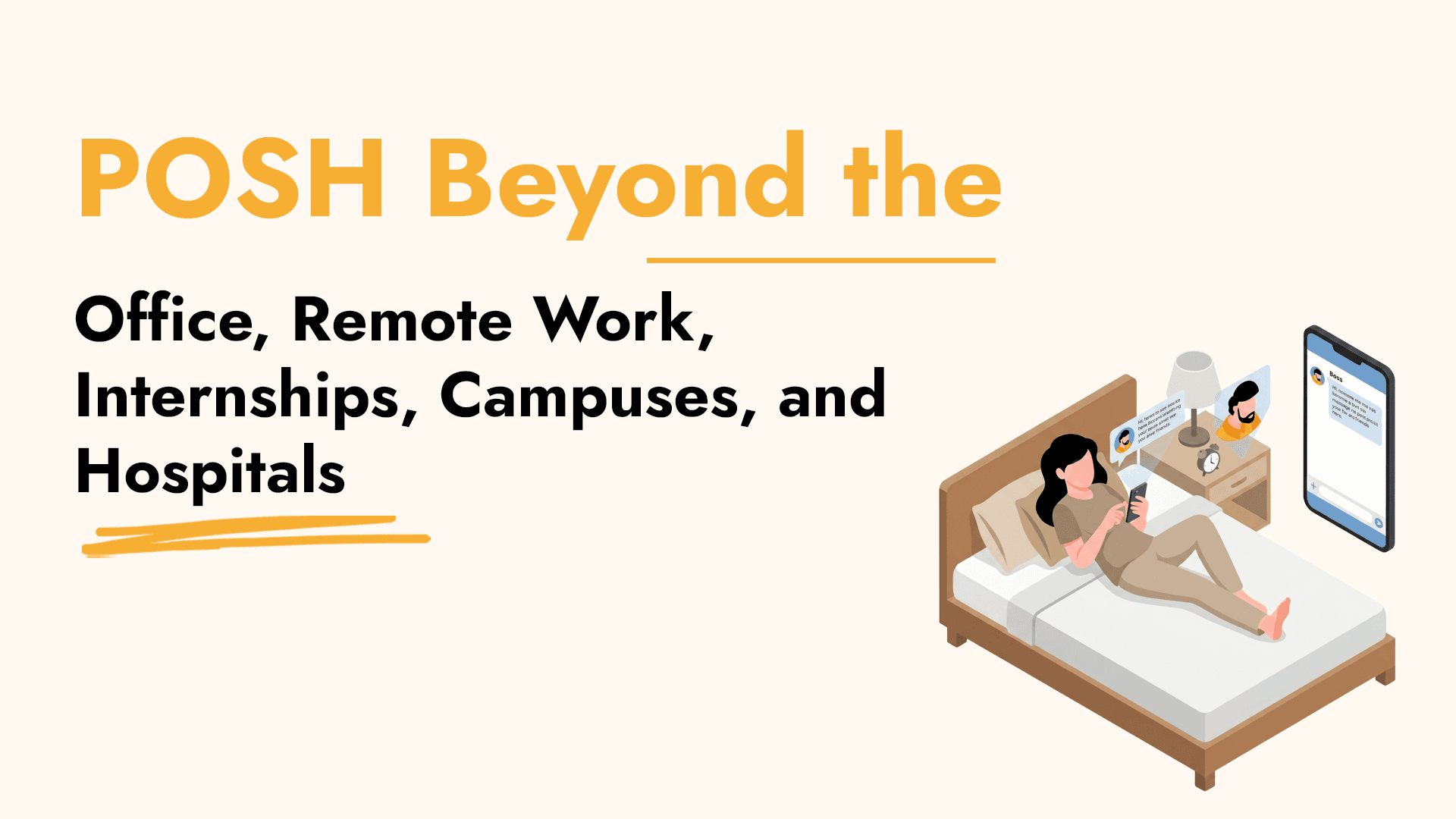
Remote and hybrid work have created new hunting grounds for harassment. Inappropriate messages on Slack or Teams. Comments on appearance during video calls. Screenshots taken without consent. Late-night calls disguised as work discussions that drift into personal territory. The POSH Act does not explicitly mention remote work, but courts have consistently held that harassment connected to the employment relationship is covered regardless of physical location.
Interns occupy a particularly vulnerable position. Many internships are unpaid. The power imbalance is enormous. The intern needs the reference, the certificate, the foot in the door. The harasser knows this and exploits it. Under the POSH Act, any woman associated with a workplace, paid or unpaid, permanent or contract, part-time or temporary, is covered. Your internship status does not diminish your rights.
Let us be clear: An unpaid intern has the same protection under POSH as the CEO's executive assistant. The law does not charge admission.
Educational institutions fall under UGC regulations that mandate Internal Complaints Committees in every college and university. Students, faculty, and staff are all covered. If your college does not have a functioning ICC, and many do not, it is in violation of both UGC norms and the law.
Healthcare is a sector in which the conditions for harassment are built into its architecture. Long hours, rigid hierarchies, exhausted workers, isolated wards, and night shifts with minimal supervision. Resident doctors, nurses, and support staff, often women, often junior, often too tired and too dependent on their seniors to resist, are particularly exposed. POSH applies fully in hospitals and clinics, yet awareness among healthcare workers is distressingly low.
A gap the law has not closed: gig economy workers, platform workers, and domestic help. The delivery woman, the beautician booked via an app, and the housekeeper who works in someone's home, their protection under POSH is unclear at best. They fall between the cracks of a law designed for formal workplaces. This needs legislative attention.
Think about this: The economy has changed. The way we work has changed. The law that protects workers needs to catch up. Until it does, awareness is the only safety net.
A Word for Parents
If your child is starting an internship, joining a new college, or working night shifts at a hospital, ask specific questions. Does the institution have an ICC? Do they know who the members are? Do they know what to do if something feels wrong? Asking these questions is not being dramatic. It is being prepared.
Zara sochiye: Preparation is not paranoia. It is the kind of parenting that matters most when it matters most.
TSSF team is eager to hear from you, write to us at info@sunitisolomon.org or call us at 044-28363200.
#POSHAct #WorkplaceHarassment #RemoteWork #HybridWork #InternshipLife #CampusSafety #HospitalWork #KnowYourRights #SafeWorkplaces #WomenAtWork #POSHAwareness #WorkplaceSafety #StudentsRights #HealthcareWorkers #GenderEquality #SpeakUp #ICC #UGCGuidelines #WomenRightsIndia #HarassmentAtWork #SafeSpaces #EmployeeRights #GigWorkers #ProfessionalBoundaries #RespectAtWork #SupportSurvivors #AwarenessMatters #TSSF #SocialChange #PreparationNotParanoia