You know that feeling. The remark that was framed as a joke but did not land. The message at midnight with no professional reason to exist. The hand on your shoulder that lingered longer than a handshake requires. The compliment about your appearance in a meeting where nobody commented on your presentation. You told yourself it was nothing. You adjusted your behaviour. You moved your chair.
It was not nothing. The law agrees with you.
Sochne wali baat: If you had to change your behaviour because of someone else's conduct, something was already wrong, regardless of what they call it.
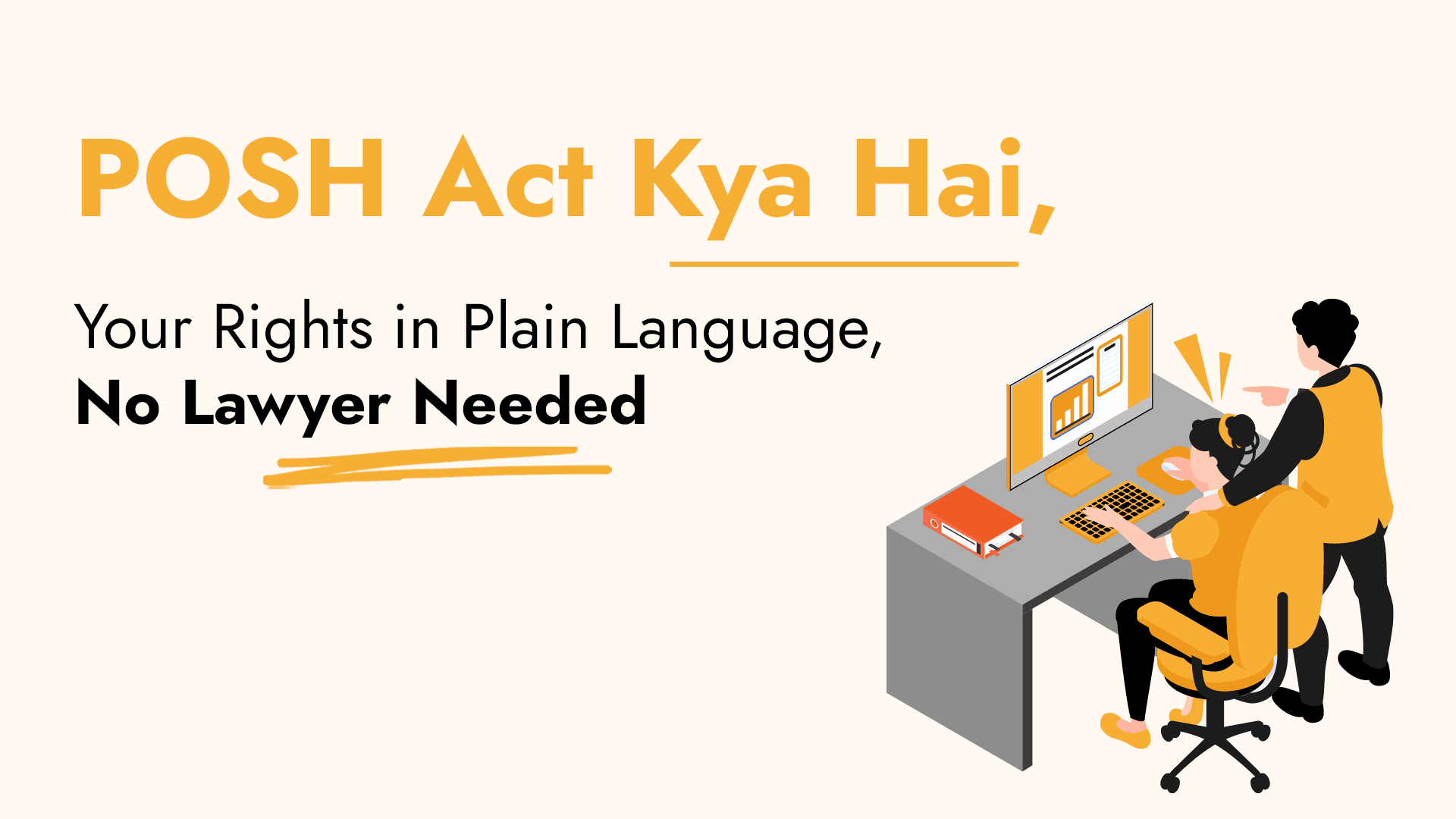
The POSH Act, Prevention of Sexual Harassment at the Workplace, was enacted in 2013, following the Supreme Court's Vishaka guidelines. It defines sexual harassment broadly: unwelcome physical contact, sexually coloured remarks, showing pornographic content, demands or requests for sexual favours, and any other unwelcome conduct of a sexual nature. That last category is deliberately wide. The yardstick is your experience of discomfort, not his claim of harmlessness.
His intention does not override your experience. Read that line twice.
Let us be specific: "I was just joking" is not a legal defence. "She took it the wrong way" is not the ICC's concern. What happened and how it affected you, that is what the law examines.
What counts as a workplace under POSH? More than most people realise. Your office, obviously. But also a client site, a work trip, a company dinner, a training programme, a conference, and, critically, your home when you are working remotely. The law follows the work, not the postal address.
Every organisation with ten or more employees must constitute an Internal Complaints Committee (ICC). If yours does not have one, your employer is already in violation. For women in the unorganised sector or in workplaces with fewer than ten employees, Local Complaints Committees operate at the district level. The SHe-Box portal (shebox.gov.in) allows women, including government employees, to file complaints online. Most people have never heard of it. That needs to change.
The POSH Act is not flawless. It has gaps, and we will address them in later blogs. But it is powerful, specific, and belongs to you. Knowing it exists is step one. Using it when needed is the step that actually makes a difference.
Think about this: A right you do not know about is one you cannot use. Knowledge here is not academic, it is armour.
A Word for Parents
If your daughter is entering the workforce, tell her about the POSH Act before she needs it. Not to frighten her, but to equip her. Tell her she has rights at work that go beyond her salary. That her instinct that something feels wrong is worth trusting. And that coming to you with a problem will never be treated as a failure, or worse, as something she brought upon herself.
Zara sochiye: Preparation is not pessimism. It is the most practical expression of love a parent can offer.
TSSF team is eager to hear from you, write to us at info@sunitisolomon.org or call us at 044-28363200.
#POSHAct #WorkplaceHarassment #SexualHarassmentAwareness #KnowYourRights #SafeWorkplaces #WomenAtWork #POSHAwareness #WorkplaceSafety #SpeakUp #GenderEquality #ICC #WorkplaceRights #WomenEmpowerment #EndHarassment #ProfessionalBoundaries #RespectAtWork #SafeSpaces #WomenRightsIndia #HarassmentIsNotAJoke #CorporateCulture #EmployeeRights #WorkplaceEthics #TrustYourInstincts #StopWorkplaceHarassment #LegalAwareness #SheBox #WomenSupportWomen #TSSF #SocialChange #AwarenessMatters