Most PoSH content deals in absolutes, clear-cut harassment on one side, acceptable behaviour on the other. But Indian workplaces are full of grey-zone behaviours that leave everyone involved confused. The lingering handshake. The "friendly" WhatsApp messages after hours. The birthday hug from a colleague you barely know. This blog names and unpacks these behaviours without becoming a legal lecture, and helps both sides, the person doing it and the person experiencing it, find clarity.
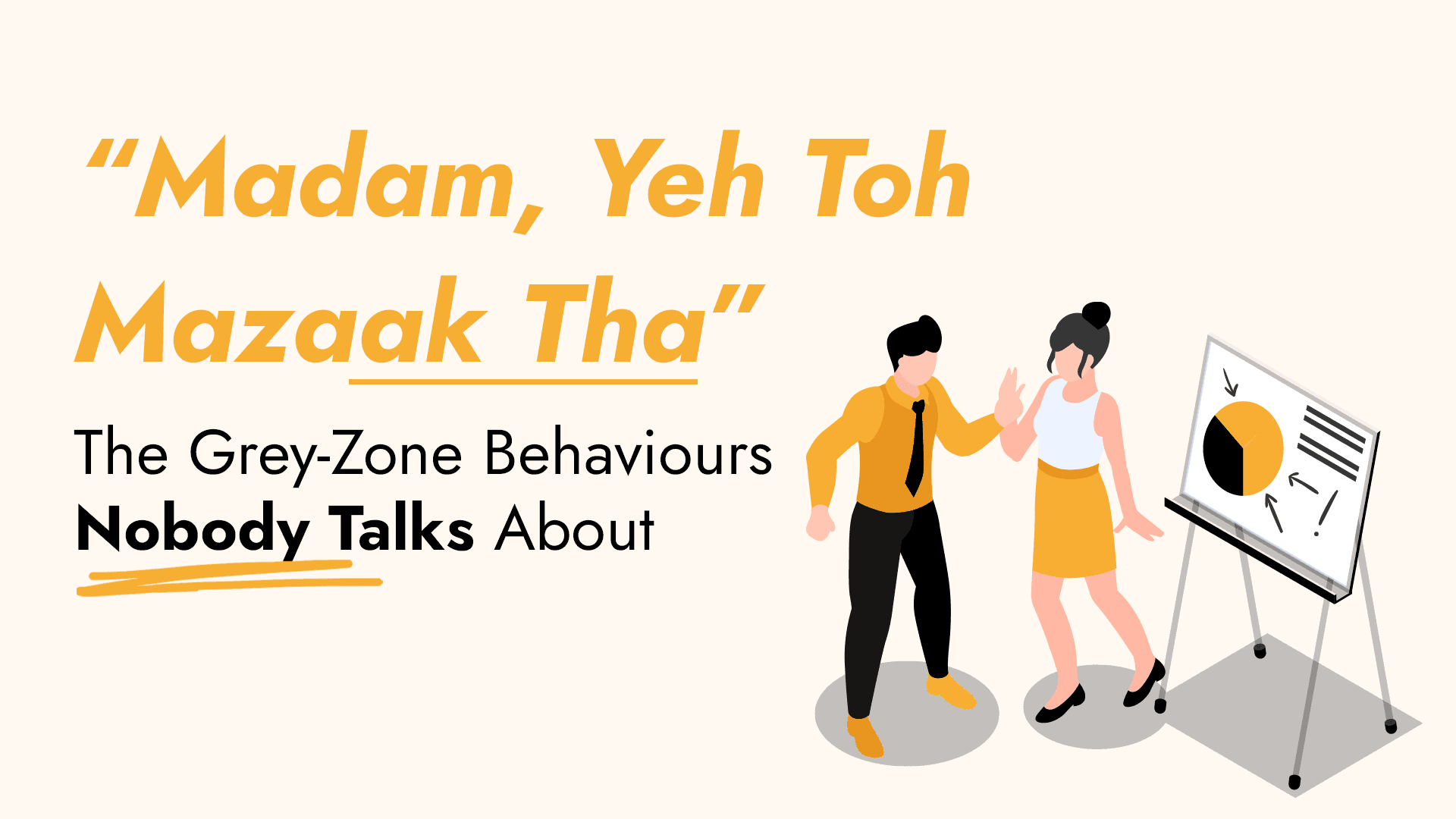
"Arre, yeh toh mazaak tha." Five words that have probably been used to dismiss more instances of workplace discomfort than any formal legal defence ever written. Someone makes a comment about how you look. You feel uneasy. You mention it to a colleague. The response is always the same, relax, it was a joke. Lighten up. Don't be so sensitive. Itna toh chalta hai.
Mazaak tab tak hai jab tak dono hans rahe hain. Jab ek insaan uncomfortable hai, woh mazaak nahi raha.
Indian workplaces have a peculiar relationship with physical proximity and verbal familiarity. A pat on the back from a senior. A hand resting on the shoulder during a conversation that lingers a beat too long. "Bahut sundar lag rahi ho aaj", said casually in front of the whole team. For many, these feel normal. Expected, even. Part of being "warm" and "approachable." But for the person on the receiving end, sometimes they feel fine, and sometimes they feel deeply wrong. The difference is not about intent. It's about impact. And impact is decided by the person receiving it, not the person delivering it.
"Maine toh achhe se kaha tha", yeh defence hai. "Unko kaisa laga", yeh sawaal hai. Dono alag hain.
Let's name some grey-zone behaviours that PoSH training rarely addresses. The WhatsApp "good morning" message with a rose emoji, sent only to female colleagues, never to male ones. The "let's discuss this over dinner" invitation that could be professional or something else. The colleague who always stands just a little too close. The senior who calls you "sweetheart", "baby" or "dear" in every conversation. The team outing where alcohol loosens tongues and "honest feedback" turns into personal commentary. Individually, none of these may cross a legal line. But cumulatively? They create an environment where someone has to be on guard all day, every day.
Harassment is not always a single big incident. Sometimes it is twenty small ones that nobody bothers to count.
Here's the uncomfortable truth, many people who engage in grey zone behaviour are not predators. They do not act with malicious intent. They genuinely believe they're being friendly, warm, or culturally appropriate. And in a country where professional and personal boundaries are culturally blurred, where your boss attends your wedding, your colleague is your neighbour, and your client's uncle knows your father, the line between familiarity and intrusion becomes genuinely confusing.
Intent matters. But it is not the only thing that matters.
So what do you do if you're the person experiencing grey zone discomfort? First, trust your instinct. If something feels off, it probably is. You don't need a legal definition to validate your unease. You don't need to consult Section 2(n) before you're allowed to feel uncomfortable. Second, if you feel safe doing so, name it. "I'd prefer that we keep our conversations professional." "I'm not comfortable with that kind of comment." You don't have to file a complaint to set a boundary. Sometimes a sentence is enough.
Boundary set karna complaint nahi hai. Yeh apni dignity ka basic requirement hai.
And if you're the person whose behaviour might fall in the grey zone, and you're reading this thinking "but I never meant it that way", stop for a moment and run a simple test. Kya aap yeh same cheez apne boss ke saamne bolte? Kya aap yeh apne male colleague ko bhi kehte? Kya aap yeh apne bete ya beti ke saamne kahenge? If the answer to any of these is no, you already know it's not just friendliness. It's selective. And selective warmth aimed at one gender in the workplace is not warmth, it's a pattern.
The simplest test: would you do this in front of an ICC member watching you? If not, don't do it at all.
PoSH training across India needs to move far beyond textbook definitions. The Act refers to "unwelcome conduct of a sexual nature." Yet nobody teaches people what "unwelcome" actually looks like in practice, at the tea break, in the lift, on the office WhatsApp group, or during the team trip to Goa. That's where the real work of prevention lies. Not in the courtroom. Not in the ICC hearing room. In the corridor. At the chai counter. In the everyday.
Real prevention doesn't start with a complaint. It starts with self-awareness. Aur woh training se aati hai, saza ke darr se nahi.
TSSF team is eager to hear from you, write to us at info@sunitisolomon.org or call us at 044-28363200.
#POSHAct #WorkplaceHarassment #SafeWorkplaces #GreyZoneBehaviour #ProfessionalBoundaries #RespectAtWork #WomenAtWork #KnowYourRights #POSHAwareness #WorkplaceSafety #CorporateCulture #HarassmentAwareness #GenderEquality #SpeakUp #EmployeeRights #PsychologicalSafety #EndWorkplaceHarassment #WorkplaceEthics #BoundarySetting #TrustYourInstincts #ConsentMatters #ProfessionalConduct #SafeSpaces #AwarenessMatters #HealthyWorkCulture #ICC #TSSF #SocialChange #ImpactOverIntent #EverydayRespect