This blog addresses something Indian PoSH conversations have largely ignored, the role of the person who witnesses it but says nothing. Most workplace harassment doesn't occur in isolation. Colleagues notice. They hear. They look away. This piece unpacks the cultural, emotional, and professional reasons for bystander silence in Indian workplaces and argues that speaking up is not heroism, it's basic responsibility.
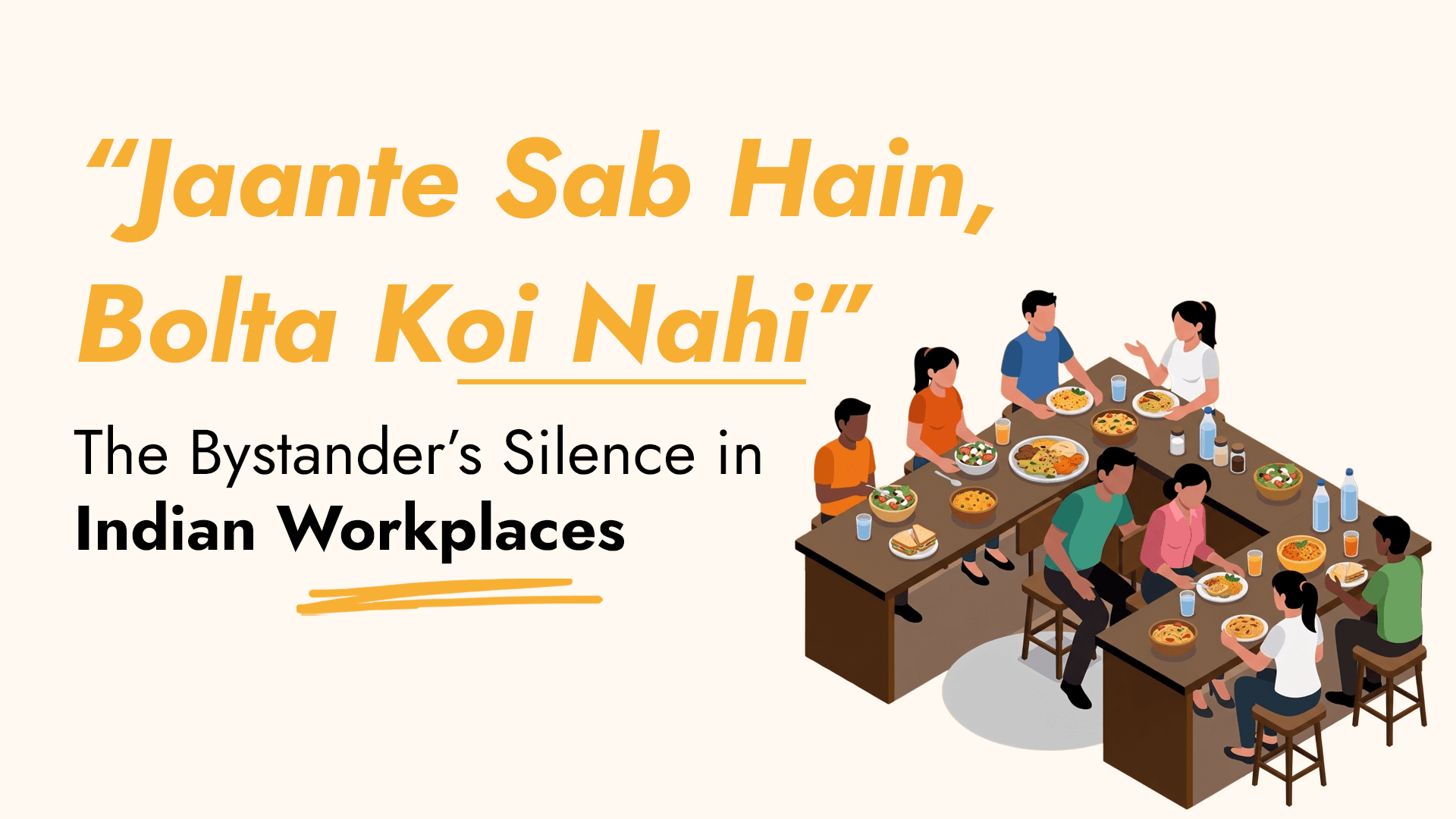
Picture this. A team lunch. The senior manager leans in a little too close to the new joiner and says something about how she looks today. Everyone at the table hears it. A few exchange glances. Someone looks down at their phone. Someone else laughs nervously. Nobody says a word. The lunch continues. The new joiner pushes food around her plate for the rest of the hour.
You weren't the one who said it, but you were there. And your silence said plenty.
This is the bystander problem in Indian workplaces. Not the harasser. Not the person being harassed. The third person, the one who saw it, knew it was wrong, and did absolutely nothing. Ye hamari problem nahi hai, ye hamara default mode hai. We are raised on "apne kaam se kaam rakho." Don't get involved. Don't create a scene. Don't become the story. Keep your head down and focus on your own career.
But when your silence renders someone else's harassment invisible, you are already part of the story.
Let's be honest about why people don't speak up. It's not always cowardice. Sometimes it's confusion, "was that really harassment, or am I reading too much into it?" Sometimes it's loyalty, the person involved is your mentor, your boss, or your friend from the training batch days. Sometimes it's plain fear, if I say something, will I be next? Will I lose my project, my promotion, my peace? These are not irrational fears. Indian workplaces run on relationships and reputations. Nobody wants to be labelled a troublemaker.
Darr valid hai. Lekin darr ke peeche chhup jaana, woh bhi ek choice hai. And choices have consequences.
Here's what most people don't realise. The PoSH Act doesn't just apply to the complainant and the respondent. The entire workplace ecosystem is meant to be part of the prevention machinery. Section 19 places obligations on the employer to create a safe environment. Every employee orientation, every awareness session, every ICC poster on the notice board, all of it is meant to signal that this is everyone's business. But laws don't change culture on their own. Culture changes when individuals decide to act differently.
A policy on the wall doesn't protect anyone. A colleague who speaks up does.
Think about it from the other side. You're the woman who just had a sexually loaded comment hurled at you in front of six people. You scan the room. Everyone avoids eye contact. Nobody flinches. What message does that send? Ki yeh normal hai. Ki tum akeli ho. Ki koi nahi bolega. That moment of collective silence doesn't just enable the harasser, it isolates the person being harassed. It tells her that what happened to her is not important enough for anyone to notice. Or worse, that everyone noticed, and nobody cared.
Ek room mein chhe log the. Aur phir bhi woh akeli thi.
Speaking up doesn't mean making a dramatic scene in the cafeteria. It can be quiet. It can be later. A message to the person, "I noticed what happened. Are you okay? Do you want to talk about it?" It can be a word to the ICC member you trust. It can be naming the behaviour in the moment, "That was a strange thing to say, yaar." It doesn't have to be a courtroom. It just has to be something. Anything that breaks the wall of silence. Because that wall is what keeps the harassment alive.
Bystander hona ek position hai. Ally banna ek decision hai.
Indian workplaces run on hierarchy, relationships, and unspoken codes. We are trained from childhood to respect elders, not to challenge authority, and to avoid conflict at all costs. That conditioning serves us in some contexts. But when someone is being harassed, it fails us completely. It fails the person being harassed and protects the person doing the harassing. The same culture of "respect" that we celebrate becomes a shield for the powerful and a cage for the vulnerable.
Izzat unki bhi hai jo chup rehti hain. Lekin izzat unki zyada hai jo baat karke saamne aati hain.
Aaj se nahi, abhi se. If you've ever been in that room, at that table, in that meeting, and you chose silence, this isn't about guilt. It's about the next time. There will be a next time. The question is: will you look away again? Or will you do the one thing that costs nothing yet changes everything, acknowledge what happened?
The next time someone is harassed in your presence, your silence will be a choice. Make a different one.
TSSF team is eager to hear from you, write to us at info@sunitisolomon.org or call us at 044-28363200.
#POSHAct #WorkplaceHarassment #BystanderIntervention #SpeakUpCulture #SafeWorkplaces #Allyship #WomenAtWork #WorkplaceSafety #KnowYourRights #CorporateCulture #RespectAtWork #GenderEquality #BreakTheSilence #SupportSurvivors #EndWorkplaceHarassment #EmployeeRights #PsychologicalSafety #LeadershipMatters #SafeSpaces #WorkplaceEthics #MenAsAllies #ICC #ProfessionalBoundaries #HarassmentFreeWorkplace #BelieveWomen #AwarenessMatters #TSSF #SocialChange #SilenceIsAChoice #BeAnAlly