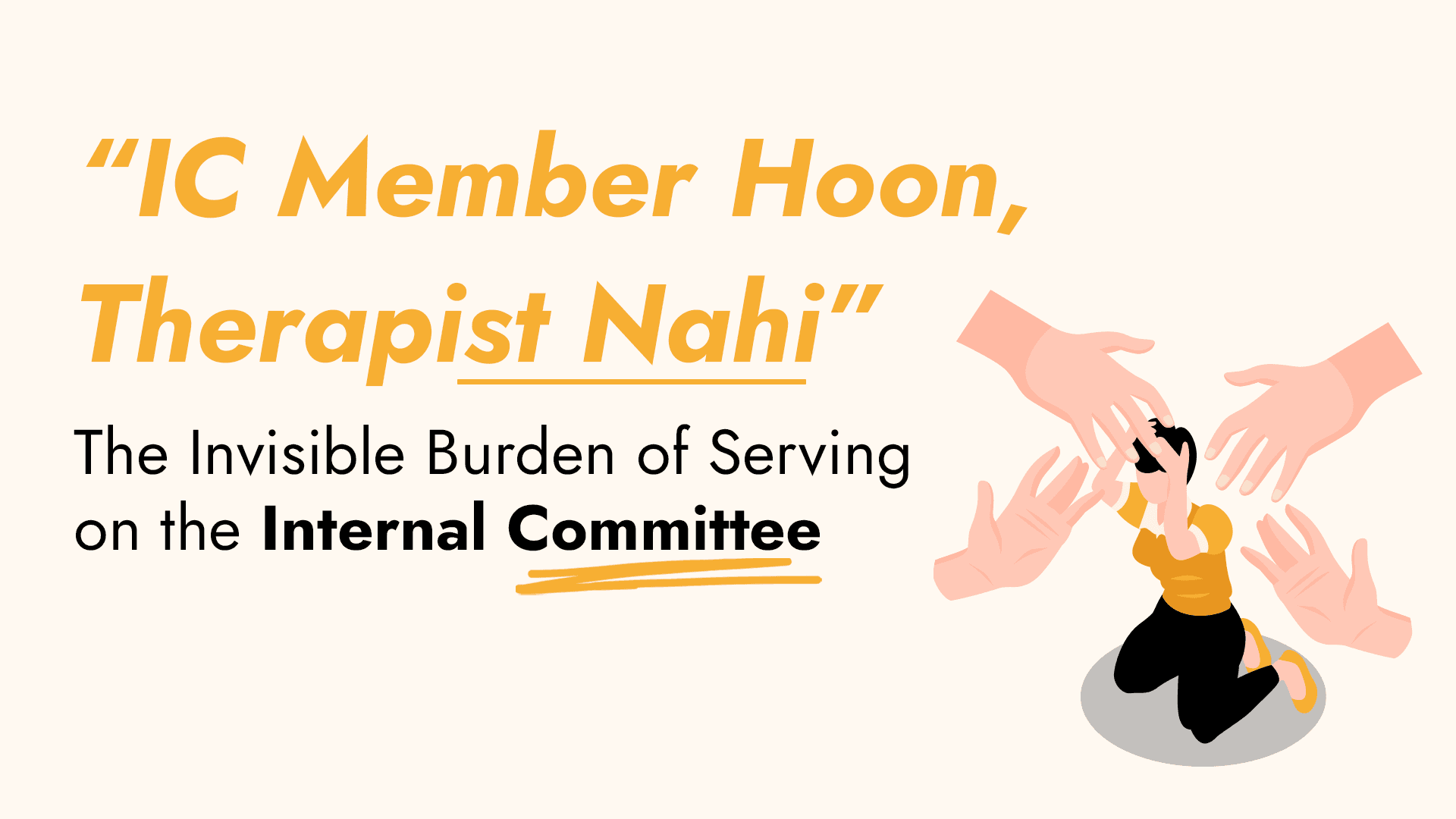
India's PoSH ecosystem talks endlessly about what IC members must do, timelines, procedures, documentation. But nobody asks how they're getting on. IC members are volunteers. They have day jobs. They didn't sign up to be counsellors, investigators, or judges. Yet they absorb graphic accounts of harassment, navigate office politics, face pressure from management, and carry it all home. This blog is for them, and about them.
She works in finance. She joined the Internal Committee because HR asked and nobody else volunteered. That was two years ago. Since then, she has sat through eleven complaints, three of which included detailed accounts of physical assault. She has heard things she cannot unhear. She has gone home after hearing days and not been able to eat dinner. She has lain awake, replaying testimony in her head. She has never once been asked, are you okay?
IC members are not robots. They are people doing an incredibly difficult job with almost no support.
The PoSH Act mandates the constitution of an Internal Committee. It sets out who should be on it, what their powers are, and how they should conduct inquiries. Bahut detailed hai, procedure ke baare mein. Timelines milenge. Documentation guidance milegi. Powers of civil court bhi milenge. But the Act is completely silent about the emotional cost of being an IC member. There is no mention of debriefing, no provision for psychological support, and no acknowledgement that listening to trauma, repeatedly, case after case, is itself traumatising.
We built the machinery. We forgot the people running it.
Secondary trauma is real. Ask any therapist, any social worker, any crisis counsellor, prolonged exposure to other people's pain leaves its mark. IC members lack the clinical training to process what they hear. They don't have supervision sessions. They don't have peer support groups. They sit in a conference room, listen to a colleague describe an assault in clinical detail, take notes as if they're recording minutes, and then return to their desks to answer emails about quarterly projections.
Koi manual nahi batata ki complaint sunne ke baad khud ko kaise sambhaalein.
And then there's the pressure. From both sides. The complainant wants justice, and wants it fast. The respondent's friends want the whole thing to go away. Management wants it resolved quietly, preferably without reputational damage to the company. HR wants documentation that will hold up if challenged. The external member wants the process followed to the letter. The IC member sits in the middle of all of this, trying to be fair, trying to be neutral, trying to remember that this is someone's life they're adjudicating. Not a file. Not a case number. A person they might pass in the corridor tomorrow.
Neutral rehna zaroori hai. But neutral rehna aasan nahi hai, especially jab dono taraf insaan hain.
Let's talk about the external member. This is the person from an NGO or legal background who, by law, must be part of every IC. In most organisations, they receive a nominal honourarium, sometimes a few thousand rupees per sitting, sometimes nothing at all. They travel to the office, sit through hearings that can run for weeks, review evidence, and help draft reports, all for a cause they believe in. But belief doesn't pay bills, and purpose doesn't prevent burnout. Many external members serve on ICs across multiple organisations simultaneously. The load is crushing.
We expect external members to bring expertise and objectivity, yet we offer them almost nothing in return.
Here's what organisations can do, starting now. Provide mandatory annual debriefing sessions for all IC members with a trained counsellor, not optional, not "if budget allows". Rotate IC membership so the same four people aren't carrying the load for years. Create a budget line for external members that genuinely respects their time and skill. Train IC members not only in legal procedure but also in self-care and emotional resilience. And most importantly, check in. A simple "how are you holding up after that last case?" from a manager goes further than any compliance checklist ever will.
Jo log doosron ki suraksha ka zimma uthate hain, unki suraksha ka zimma kaun legega?
IC members across India are quietly burning out. They are developing anxiety about hearing days. They are losing sleep after particularly difficult cases. Some stop attending meetings altogether because they can't take it any more. And then organisations complain about IC members being "inactive" or "unresponsive", as if the problem were laziness, not exhaustion.
We broke them, and then we blamed them for being broken.
If you are an IC member reading this, know that your exhaustion is not a weakness. It is the natural cost of doing deeply human work in a system that treats you like a compliance checkbox. You deserve better. And if your organisation isn't giving you that, say so. Out loud. Because if the people who protect others can't protect themselves, the entire system falls apart.
You are not merely a committee member. You are a human being who chose to stand between harm and safety. That matters.
TSSF team is eager to hear from you, write to us at info@sunitisolomon.org or call us at 044-28363200.
#POSHAct #InternalCommittee #ICMembers #WorkplaceHarassment #SafeWorkplaces #MentalHealthMatters #SecondaryTrauma #WorkplaceSafety #POSHAwareness #CorporateCulture #EmotionalBurnout #SupportICMembers #WomenAtWork #WorkplaceEthics #PsychologicalSafety #EmployeeWellbeing #LeadershipMatters #HarassmentFreeWorkplace #RespectAtWork #SupportSystemsMatter #BurnoutAwareness #TraumaInTheWorkplace #HRLeadership #SafeSpaces #EmotionalResilience #ComplianceAndCare #TSSF #SocialChange #CareForTheCaregivers #WorkplaceWellbeing