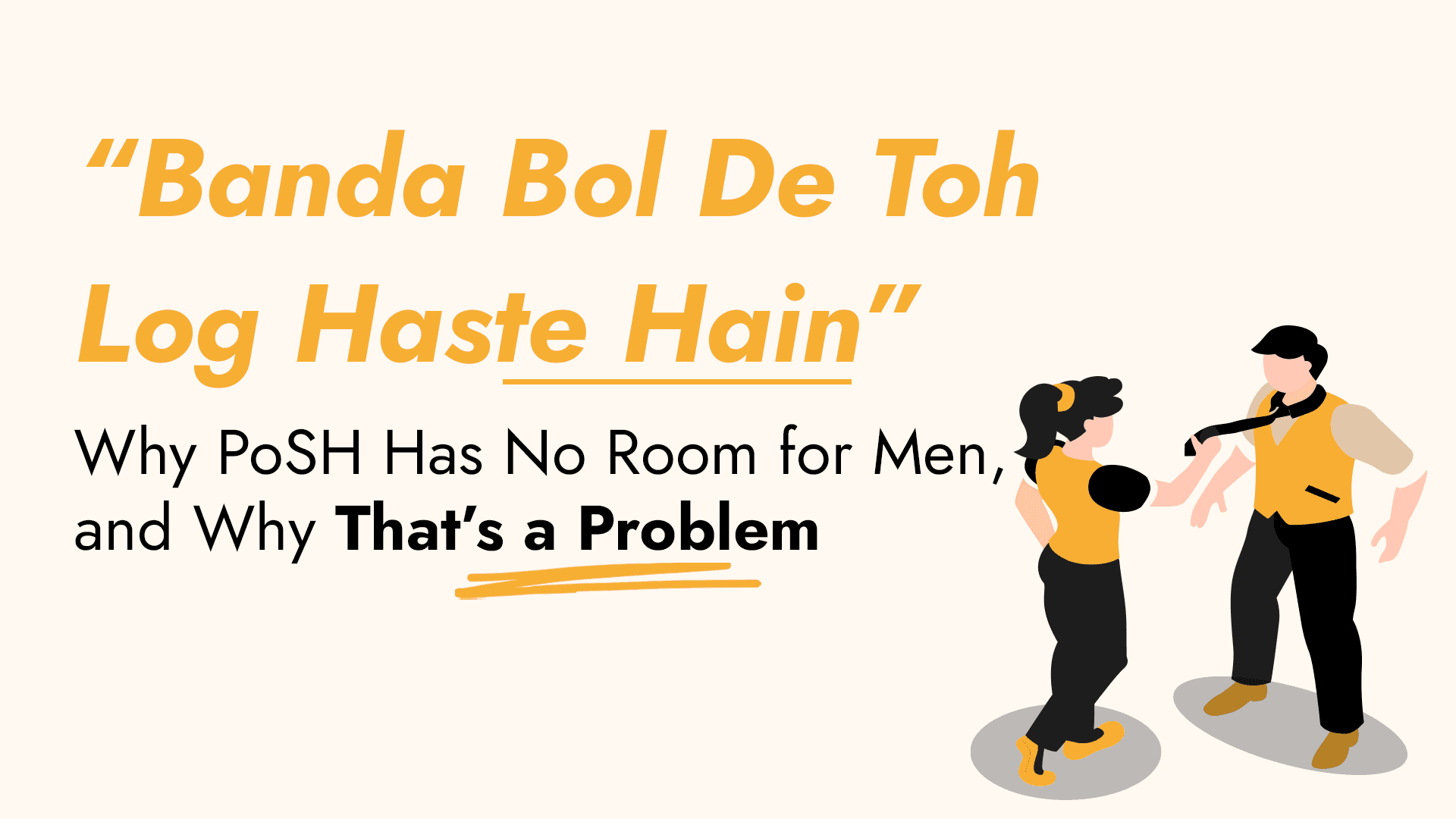
This blog does not argue against the PoSH Act's focus on women, it acknowledges why that focus was and remains necessary. But it raises a question the law has not answered: what happens when a man, a queer person, or a transgender man faces sexual harassment at work? The Act offers them no statutory mechanism. This blog explores that gap, not as a men's rights polemic, but as a dignity and constitutional inclusion issue rooted in Indian workplace realities.
He's 26 and works at a mid-sized IT firm in Pune. His female team lead has been sending him late-night messages that have nothing to do with work. "Missed you in the meeting today" with a wink emoji. "You should wear that blue shirt more often." "Why didn't you reply, angry with me?" He showed the messages to a colleague he trusts. The colleague looked at the screen, then back at him, and laughed. "Bhai, tujhe toh lottery lagi hai."
When a man reports harassment, the first response is often a joke. That tells you everything about where we are.
The PoSH Act is clear in its language. Only an "aggrieved woman" can file a complaint under its provisions. The law was written to protect women, and given the scale, severity, and systemic nature of sexual harassment women face in Indian workplaces, that focus was entirely justified. The Vishaka Guidelines that preceded it, the years of women's rights activism, and the data on gender-based violence at work, all of it demanded a law that centred women's lived experiences. That context is real, historical, and must not be dismissed or minimised.
The Act was born of women's pain. That origin is valid. But the question is, does the law's reach now need to expand?
Here is the reality the law currently doesn't account for. Men get harassed at work. Not at the same scale as women, not with the same systemic power dynamics backing it, but it happens. A male junior targeted by a male senior through sexual jokes and innuendo. A young male employee subjected to homophobic remarks disguised as office "banter." A man whose female supervisor makes repeated physical contact he hasn't consented to. These situations exist in Indian workplaces. And when they arise, the man has no recourse under the PoSH Act. He can't approach the ICC. There is no statutory committee designed to hear him.
Agar kanoon mein jagah nahi hai, toh insaan kahan jaaye?
The gap is even starker for queer and transgender individuals. A transgender man, legally male, faces harassment at work. The PoSH Act doesn't cover him because he is not a woman under the Act's definition. The Transgender Persons (Protection of Rights) Act, 2019 has limited workplace provisions and almost no on-the-ground implementation infrastructure. He falls through every crack in the legal system. A gay man subjected to daily sexual comments from colleagues, again, no PoSH protection. He can try the Bharatiya Nyaya Sanhita, but those provisions are criminal in nature and were not designed for everyday workplace harassment.
Inclusion ka matlab sirf Pride month mein rainbow logo lagana nahi hai. Inclusion ka matlab hai, protection for all.
Some progressive organisations have already gone beyond the statute. They have implemented gender-neutral anti-harassment policies as part of their internal service rules, extending the ICC's jurisdiction to complaints from employees of all genders. This is legally permissible, the PoSH Act doesn't prohibit going beyond the statutory minimum, and companies are free to provide broader protections. But these are the exception, concentrated mostly among large MNCs in metros. Most Indian workplaces, especially in Tier 2 and Tier 3 cities, and in manufacturing, hospitality, healthcare, and education, have only what the law mandates. And the law mandates protection for women alone.
Kanoon se aage jaana company ki choice hai. Lekin kanoon ko aage le jaana, woh sarkar ki zimmedaari hai.
In 2013, the Justice Verma Committee explicitly recommended a gender-neutral framework for workplace harassment law. In 2023, the Supreme Court refused to make the Act gender-neutral, arguing that doing so would dilute protections specifically meant for women under Article 15(3) of the Constitution. Both positions have genuine merit. The fear that gender neutrality could be weaponised to file counter-complaints against women or create a false equivalence between structurally different experiences is not unfounded. But the answer to that fear cannot be to leave entire categories of people with zero statutory protection.
Auraton ki suraksha kam karne ki zaroorat nahi hai. Baakiyon ki suraksha shuru karne ki zaroorat hai.
This is not about pitting men against women. This is not a competition for victimhood. This is about recognising a straightforward constitutional principle, that dignity at work is not a gendered right. It is a human right. Article 14 guarantees equality before the law. Article 15 prohibits discrimination on the grounds of sex. Article 21 protects life and personal liberty, which courts have consistently interpreted as including the right to dignity. A legal framework that leaves some people entirely without protection against workplace harassment, solely because of their gender identity, sits uncomfortably with these foundational principles.
Samvidhaan sabka hai. Suraksha bhi sabki honi chahiye.
TSSF team is eager to hear from you, write to us at info@sunitisolomon.org or call us at 044-28363200.
#POSHAct #WorkplaceHarassment #GenderNeutralLaws #SafeWorkplaces #DignityAtWork #LGBTQInclusion #WorkplaceSafety #KnowYourRights #InclusiveWorkplaces #WomenAtWork #QueerRights #TransRights #EmployeeRights #HarassmentAwareness #GenderEquality #MentalHealthMatters #RespectAtWork #BreakTheSilence #CorporateCulture #SafeSpaces #EqualityForAll #HumanRights #WorkplaceEthics #SupportSurvivors #LegalAwareness #PsychologicalSafety #TSSF #SocialChange #InclusionMatters #ProtectionForAll